TOP-Energy® in 
Teaching and Research

Modeling, Simulation and Optimization of Energy Systems in Higher Education

The transformation of modern energy systems is one of the key challenges of the energy transition. Topics such as decarbonization, energy efficiency, sector coupling, and the integration of renewable energies are increasingly shaping education in energy and environmental engineering.

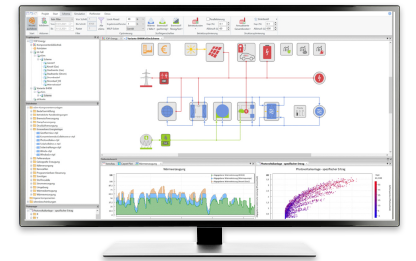
With TOP-Energy, universities gain a software tool that enables students to model, simulate, and analyze complex energy systems. This allows technical interrelationships to be not only taught theoretically but also demonstrated through realistic scenarios.

Students learn how electricity, heat, cooling, steam, and compressed air systems interact, how energy flows change, and which strategies contribute to the optimization and decarbonization of energy systems.

Free Use of TOP-Energy 
for Universities and Colleges

For teaching purposes, we provide free licenses for universities and higher education institutions. Lecturers and students can use them to model energy systems of various scales—from campus networks to cross-sectoral systems.

TOP-Energy is ideally suited for

  • Semester-long exercises
  • Intensive block courses
  • Practice-oriented project work

Integrating TOP-Energy Into Your Teaching

Would you like to integrate TOP-Energy into your courses and give students hands-on access to the simulation and optimization of modern energy systems? Upon request, we provide free teaching materials in addition to the license. Comprehensive training videos and tutorials are also available for self-study.

From Theory to Practice: Sample Teaching Scenarios for the Analysis of Industrial Energy Systems

TOP-Energy provides virtual use cases that reflect typical challenges in industrial energy supply, sector coupling, and system decarbonization. These scenarios are based on real applications in industry and energy system technology, allowing students to analyze current energy transition challenges such as energy efficiency, CO₂ reduction, and integrated energy systems.

Note: The location can be freely changed for each scenario. Weather data and load profiles can be imported or generated quickly.

Your University Campus: Sustainable Energy Supply With Renewables

The goal is to make your university’s campus energy supply more sustainable. Electricity is largely sourced from the grid, while a decentralized heating network supplies the buildings, and several roofs are already equipped with photovoltaic modules.

How can renewable energies be used to decarbonize power and heat generation and increase the efficiency of your campus energy system? In this assignment, students compare different concepts and evaluate their economic and ecological impact.

Note: Students analyze CO₂ emissions of system components, assess the economic viability of systems, and perform a technology comparison of different variants
Level: Introductory
Courses: Engineering, especially Energy and Environmental Engineering, Energy Systems, or Industrial Engineering

Autonomous Island System: Integrated Power and Heat Supply From Renewable Sources

At remote locations without a reliable grid connection, the energy supply for electricity, heat, and cooling must be secured entirely on-site—365 days a year. At the same time, energy demand fluctuates, for example when guest numbers change on weekends. How can such an autonomous energy system be operated efficiently and reliably? Students explore this question using examples such as the Watzmannhaus, the Brocken Hotel, and a hotel in the port of Heligoland.

Note: This scenario focuses on measures to reduce CO₂ emissions, increase energy autonomy, and expand the overall system
Level: Introductory
Courses: Engineering, especially Energy and Environmental Engineering, Energy Systems, or Industrial Engineering

Combined Cycle Power Plant (CCPP): Decarbonizing an Industrial Site in Brandenburg Through Integrated Energy System Simulation

A modern industrial site in Brandenburg faces the challenge of meeting its high electricity and steam demand efficiently and sustainably. At the same time, large amounts of green hydrogen must be supplied for the local chemical industry. How can renewable energies, simulation techniques, and advanced process optimization improve energy use and reduce costs? This is exactly what students examine in this project.

Note: This assignment combines technical analysis, process simulation, and strategic energy planning, offering a practical insight into modern industrial energy supply using TOP-Energy
Level: Advanced
Courses: Thermodynamics, Process Engineering

Battery Storage in the Energy Market: Control Energy, Power Trading (Day-Ahead Market) and Peak Shaving Optimization

This teaching project is currently under development.

Level: Expert

TOP-Energy for 
Research and Development

TOP-Energy offers customized licenses for research and development at universities, colleges, and research institutions. Enable innovative analyses, prototype development, and feasibility studies in complex energy systems—with full modeling, simulation, and optimization functionality.

Non-commercial R&D use: one-year license at a strongly reduced rate compared to the commercial license.

Mixed commercial and non-commercial R&D use: one-year license at a significantly reduced rate.