01
Security of supply under failure conditions
Simulation of blackout, attack, and island operation scenarios for critical infrastructure and properties.
Military properties must remain operational even in the event of a failure of external energy sources. For sites with critical infrastructure, a secure, resilient, and as self-sufficient as possible energy supply is crucial to ensuring energy security and operational capability even in crisis situations.
Simulation of blackout, attack, and island operation scenarios for critical infrastructure and properties.
Integrated modeling and comparison of photovoltaics, storage, heat pumps, and hydrogen systems.
Analyze load profiles, storage behavior, and supply situations for every quarter-hour of the year.
Model energy generators, storage systems, consumers, and grids in a transparent digital representation of the property.
Compare supply security, self-sufficiency, and energy flows across different scenarios.
Weigh security of supply, self-sufficiency, economic efficiency, and climate protection against one another in realistic scenarios.
A secure and resilient energy supply is a key factor for operational readiness, deterrence, and sustainability. Especially at armed forces facilities with critical infrastructure, communication, analysis, and operational processes must be safeguarded even during prolonged disruptions or power outages.
Existing supply structures reach their limits when, in the event of a crisis, they rely primarily on external grids or temporary diesel emergency power supplies. This is precisely where simulation-based planning of resilient supply concepts comes into play.
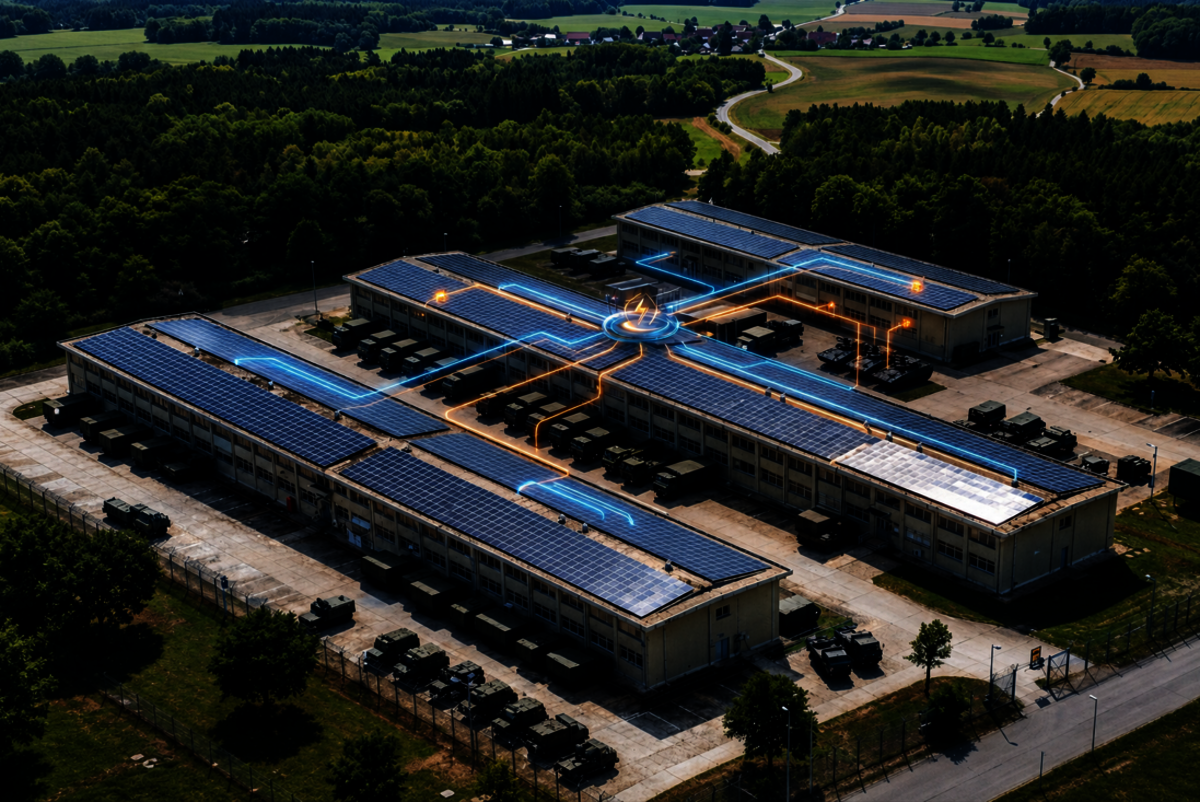
TOP-Energy enables the simulation of blackout- and attack scenarios in order to realistically evaluate the supply of critical infrastructure even during grid outages.
Photovoltaics, battery storage, heat pumps and hydrogen systems can be dimensioned in a way that significantly reduces dependence on external energy sources and diesel.
Comparing different supply concepts and scenarios creates a reliable basis for the strategic expansion of resilient energy infrastructures.
To illustrate this use case, we model and optimize an example scenario of a typical militaryproperty in TOP-Energy—and compare various supply concepts under realistic crisis conditions.
Armed Forces properties today rely heavily on external energy supplies and the public grid. In the event of widespread power outages, critical areas would often be secured using diesel emergency generators, which in turn rely on a continuous fuel supply during prolonged crisis scenarios.
For sites with security-critical IT, server rooms, communication systems, or command and control support, this dependency poses a risk. Therefore, we are seeking supply concepts that function even in off-grid mode and can reliably safeguard critical loads.
Overview of the example scenario
The scenario examines a military facility with housing, security-critical IT infrastructure, and a vehicle fleet. It simulates a one-month power outage resulting from an attack on critical infrastructure.
Stored load profiles (per year)
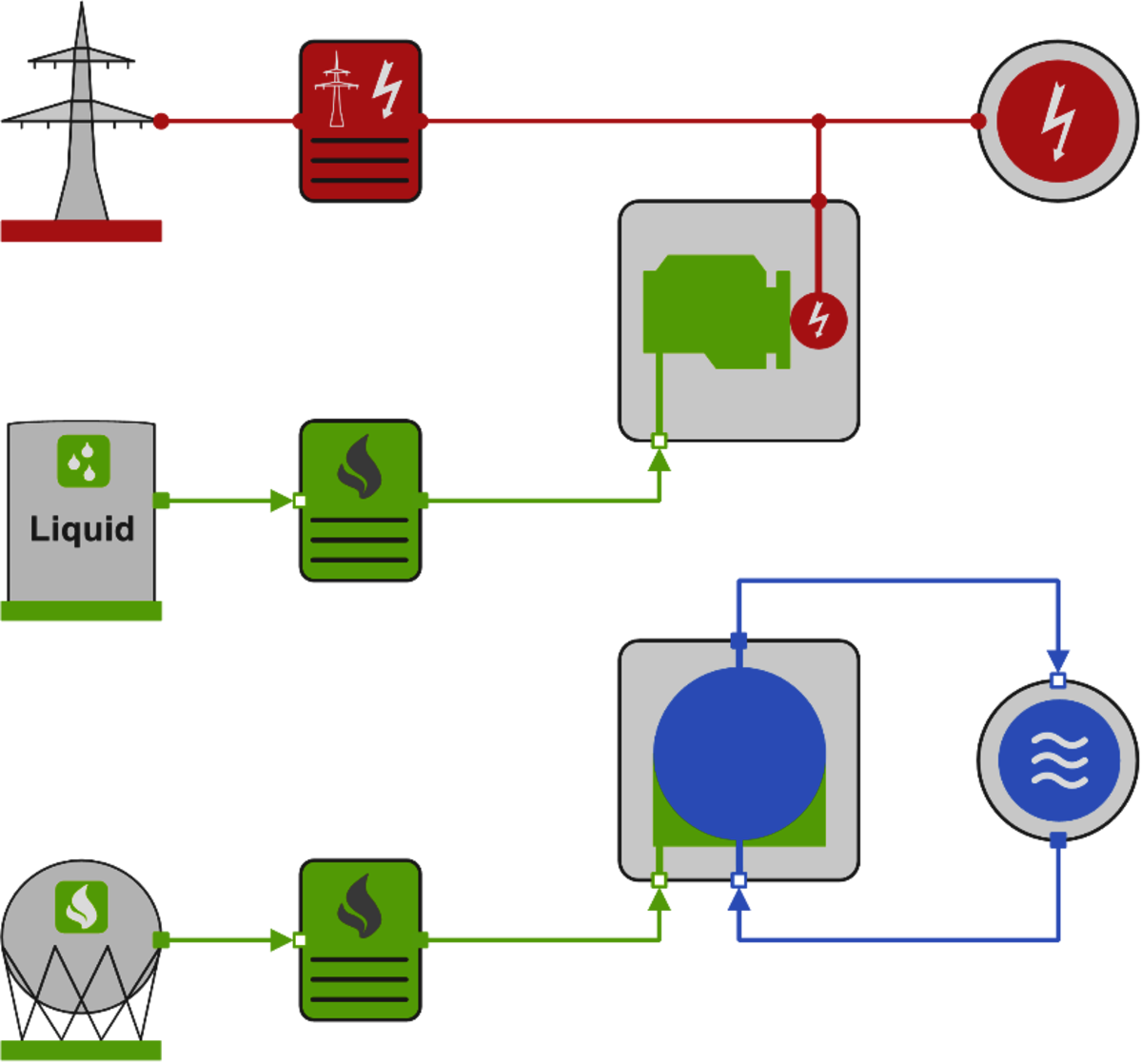
Current Situation
Electricity is supplied from the grid, and heat is generated by a boiler. The electricity required for cooling is factored into the electricity load profile. Diesel generators are on standby in case of a power outage—assuming that fuel is delivered every three days.
Energy generators, storage systems, consumers, and grids are linked together using a diagram editor. These graphical models enable the comparison of various structurally different supply options. On this basis, different systems can be transparently compared and strategically evaluated. In doing so, conflicting objectives such as cost-effectiveness, sustainability, and resilience can be examined.
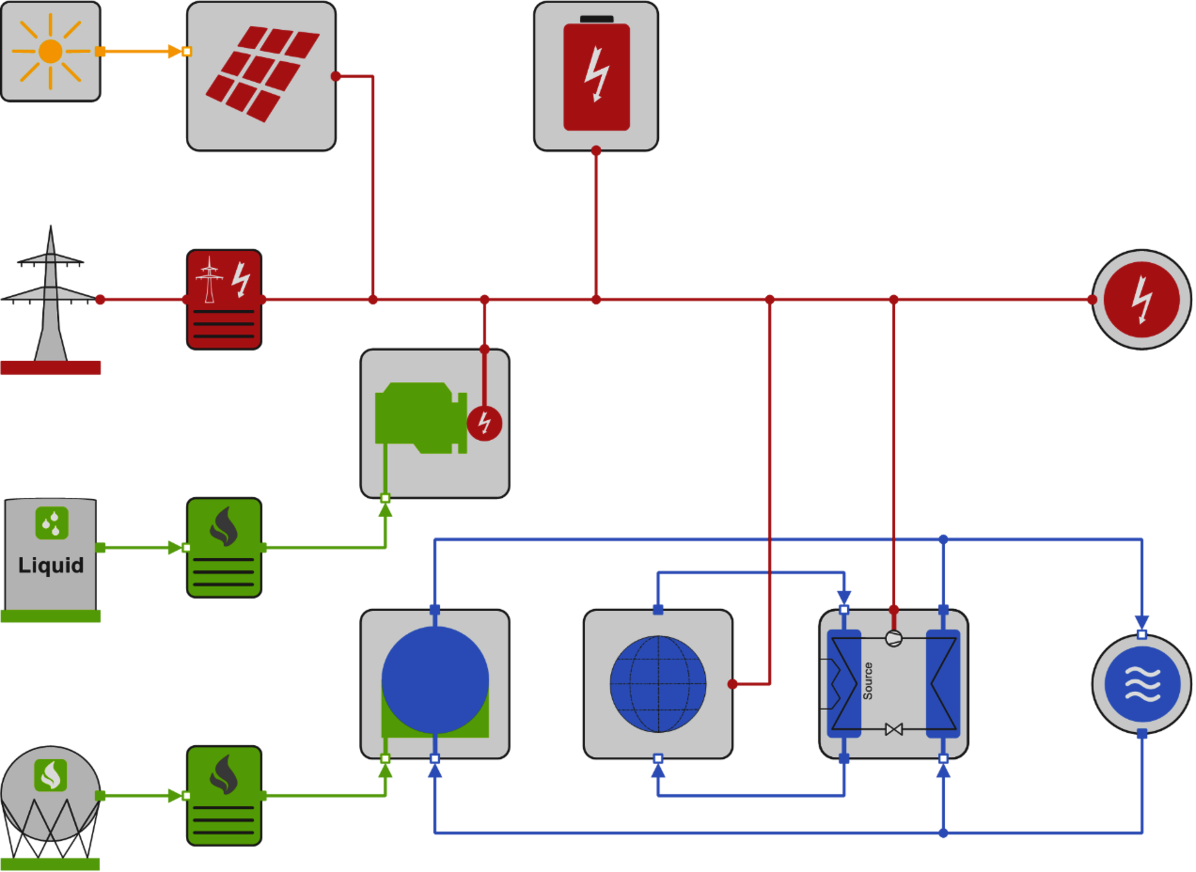
As part of the simulation, various supply options are compared to quantify their contribution to resilience, self-sufficiency, and security of supply.
Options
Battery sizes (varies)
Simulated Scenarios
The simulation shows that simply installing the PV system reduces diesel consumption during a one-month summer outage from 394.8 MWh to 177.2 MWh—meaning only half the usual supply is required. With a 2-MWh battery storage system and load shedding, as much as 95.8% of the diesel is replaced in the summer.
Regardless of grid reliability, the battery pays for itself with just one megawatt-hour after only 4 years—so resilience here is not merely a cost item, but also economically viable.
The tables compare diesel consumption over a one-month power outage in July—once with all loads, and once with load shedding. Server room cooling continues unchanged in both scenarios; only non-critical loads are reduced.
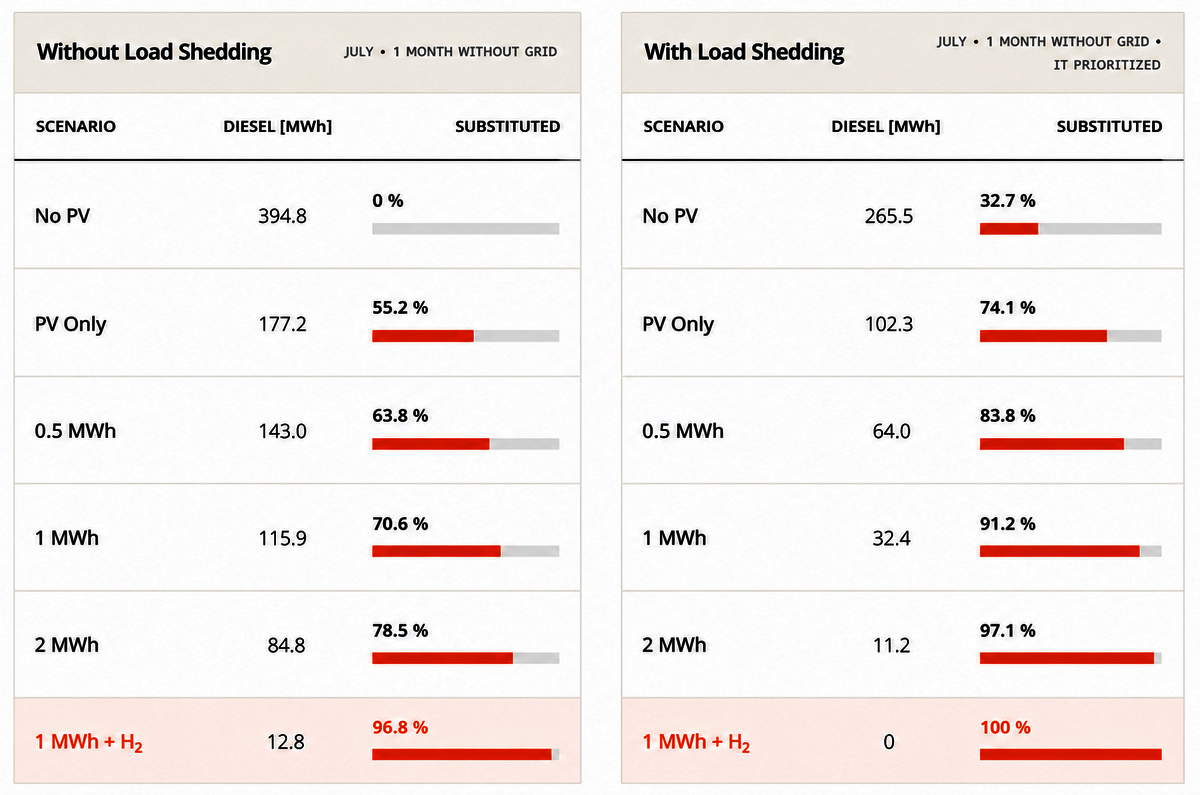
Medium-sized battery storage (1 MWh) + load shedding compared to the pure diesel baseline scenario.
During regular site operation — through PV self-consumption, heat pumps and battery storage.
Dynamic amortization (1 MWh) — independent of the strategic value of resilience.
The systems featuring photovoltaics and energy storage have payback periods of approximately 4 years and extend the property’s self-sufficient operation by more than double. In addition, they reduce CO₂ emissions by more than 60% during normal operation.
They can compensate for outages in both the power grid and the gas network and bridge longer periods. In this way, TOP-Energy creates a robust basis for decision-making regarding resilient energy supply concepts in military properties—especially for security-critical systems such as server rooms, IT infrastructure, and central operational functions.
In winter, PV generates little or no electricity over extended periods—while demand tends to be higher due to heating requirements. Overproduction of hydrogen from the summer PV surplus significantly extends self-sufficiency even in winter. This is precisely where the strategic value of hydrogen in the supply concept becomes evident.
With an overbuild of photovoltaic capacity and large-scale hydrogen storage on site, hydrogen offers strategic advantages over purely electrical storage due to its transportability and mobile usability.
TOP-Energy enables the transparent evaluation of costs, benefits and security of supply for different supply concepts — including the question of when hydrogen truly pays off compared to battery storage.
With battery storage, the facility is (n−1) secured, meaning that the failure of one component does not lead to a complete shutdown.
With an additional electrolyzer–fuel cell combination, an even higher level of resilience is achieved — both the grid and the battery may fail while the facility remains supplied.
Interpretation: Duration of operation in days without additional diesel supply. Scale 0–15 days — the H₂ scenario lasts significantly longer and is truncated.
Simulation and evaluation of complex energy systems — directly usable by your team. Model libraries for electricity, heating, cooling, storage and hydrogen.
Support for the modeling, evaluation and optimization of individual energy systems — from load profiles to scenario-based studies.
Customized applications for standardized analysis and evaluation processes.