How do chemical parks plan, simulate, and optimize such energy systems?
From Research to Implementation
In the BMWK-funded research project “TransTES-Chem” (FKZ 03ET1646A-E), DLR, TSK Flagsol Engineering, JPM Ingenieurtechnik, and GFaI e. V.—drawing on the expertise of the chemical companies Covestro and Currenta—worked with TOP-Energy to explore integration options for high-temperature thermal storage systems and power-to-heat plants within an idealized chemical park model (iCV). This generic model enabled general conclusions to be drawn about technology integration without directly mapping specific locations such as Brunsbüttel.
“The biggest challenge with thermal storage in large industrial plants is finding use cases that ultimately result in a viable business case,” explains Dr.-Ing. Stefan Kirschbaum, Head of Energy Systems Engineering at TOP-Energy. “To integrate storage systems meaningfully into complex energy systems, all the advantages of these technologies must be evaluated. In addition to purely operational benefits, such as taking advantage of variable energy costs, the value of greater flexibility and more freedom in choosing energy sources must also be assessed.”
One model to rule them all? General or specific optimization models?
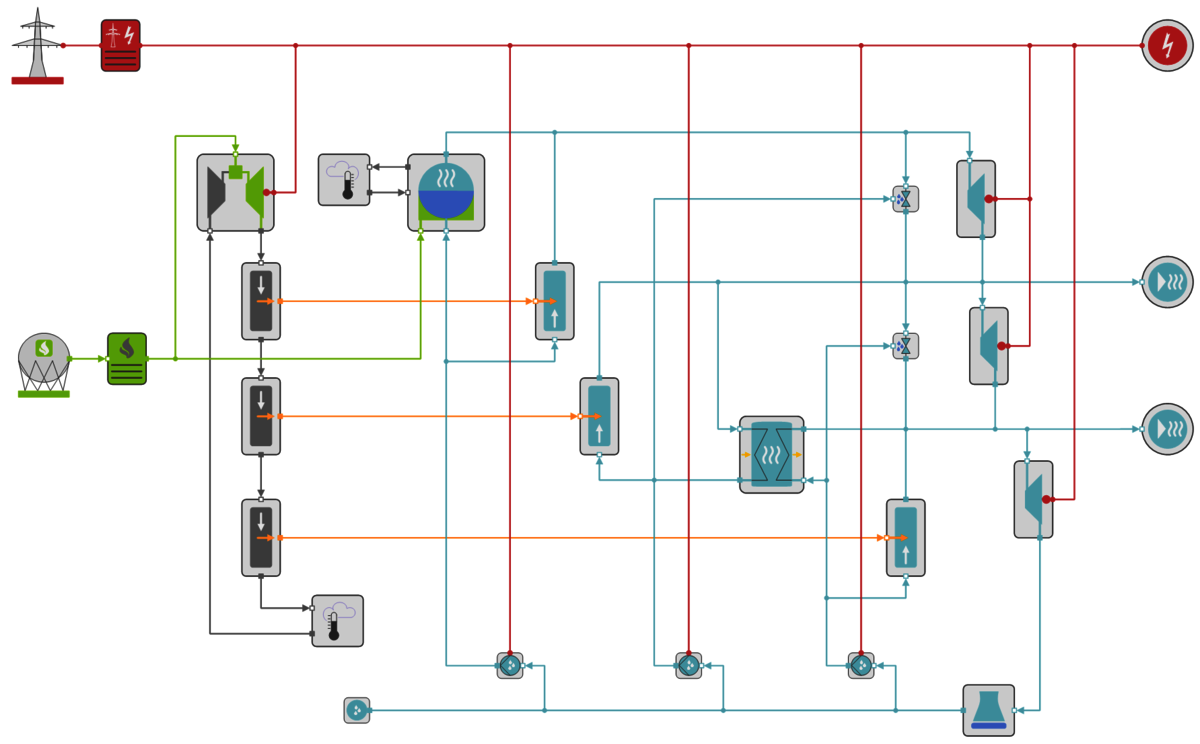
As part of the research project, exemplary energy systems were modeled in TOP-Energy based on expertise from Currenta and Covestro as well as literature data. The goal was to evaluate power-to-heat plants and high-temperature heat storage systems (e.g., molten salt) within an ideal-typical chemical park supply structure (iCV, DOI: 10.1002/cite.202100164)—as a generic model for chemical parks. The ideal-type chemical park supply structure allows for the evaluation of specific technologies without specifically modeling the conditions of a particular site. In this way, it is possible to make general statements about specific technologies for a broad spectrum of chemical parks. The research project has shown that directly charging thermal storage systems with steam is uneconomical in most cases. It makes much more sense to convert cheaply purchased electricity into thermal energy and store it in this form—an approach that specifically exploits fluctuations in the electricity markets. Since the volatility of electricity prices is expected to continue to increase, this advantage is likely to become even more significant in the future.